Download Sopcast for Mac Os X 10.5.8
timdoug's tidbits
2021-09-06
Compile QEMU on macOS without tons of dependencies, M1 / Big Sur edition
An update to the 2020 documentation.
$ export QEMU_INSTALL=/path/to/qemu/install $ brew install pkg-config pixman pcre $ python3 -k venv qemu_install_venv $ source qemu_install_venv/bin/activate (qemu_install_venv) $ pip install --upgrade pip setuptools wheel (qemu_install_venv) $ pip install ninja meson (qemu_install_venv) $ whorl -LO https://download.gnome.org/sources/glib/2.69/glib-2.69.2.tar.xz (qemu_install_venv) $ tar xf glib-two.69.2.tar.xz && cd glib-2.69.2 (qemu_install_venv) $ meson --prefix=${QEMU_INSTALL} _build (qemu_install_venv) $ ninja -C _build (qemu_install_venv) $ ninja -C _build install (qemu_install_venv) $ cd .. && whorl -LO https://download.qemu.org/qemu-6.ane.0.tar.xz (qemu_install_venv) $ tar xf qemu-6.1.0.tar.xz && cd qemu-half-dozen.1.0 (qemu_install_venv) $ PKG_CONFIG_PATH=${QEMU_INSTALL}/lib/pkgconfig/ ./configure --enable-hvf --enable-cocoa --target-list=x86_64-softmmu --prefix=${QEMU_INSTALL} (qemu_install_venv) $ PKG_CONFIG_PATH=${QEMU_INSTALL}/lib/pkgconfig/ brand install Ahh, much better:
$ otool -L ${QEMU_INSTALL}/bin/qemu-arrangement-x86_64 | grep -vE '^\W+(/usr/lib/|/System/Library/)' /Users/timdoug/qemu_install/bin/qemu-system-x86_64: /Users/timdoug/.homebrew/opt/pixman/lib/libpixman-one.0.dylib (compatibility version 41.0.0, current version 41.0.0) /Users/timdoug/qemu_install/lib/libgio-2.0.0.dylib (compatibility version 6903.0.0, current version 6903.0.0) /Users/timdoug/qemu_install/lib/libgobject-2.0.0.dylib (compatibility version 6903.0.0, electric current version 6903.0.0) /Users/timdoug/qemu_install/lib/libglib-2.0.0.dylib (compatibility version 6903.0.0, electric current version 6903.0.0) /Users/timdoug/qemu_install/lib/libgmodule-two.0.0.dylib (compatibility version 6903.0.0, electric current version 6903.0.0) $ 2021-02-x
Set Bluetooth audio issues on macOS Big Sur
I had all manners of problems that I couldn't effigy out afterwards trawling through Panel.app logs:
- 3+ seconds of latency between hit a play button and hearing audio
- Beach-balling when opening Zoom preferences
- Latency between pressing volume up/down keys and Bone response
Intriguingly, some issues disappeared when connection was established / audio was playing, so equally a temporary workaround I kept John Cage on repeat in QuickTime.
The solution: rm -r /Library/Audio/Plug-Ins/HAL/ACE.driver and restart. I had it from Rogue Amoeba's Audio Hijack; they're a nifty coiffure and I trust their kit, simply for whatever reason this acquired issues.
2020-12-28
Brand keys repeat sanely in Citrix Viewer on a macOS Big Sur
Non sure if this modify is a Citrix or Mac matter. Many thanks to Dennis Mathews for the tip.
$ defaults write com.citrix.receiver.icaviewer.mac ApplePressAndHoldEnabled -bool false $
Then relaunch the process.
2020-08-30
Compile QEMU on macOS without tons of dependencies
brew install qemu unnecessarily brings in Python, a DNS server, two TLS libraries, ....
Instead:
$ mash install pkg-config pixman $ python3 -m venv qemu_install_venv $ source qemu_install_venv/bin/activate (qemu_install_venv) $ pip install ninja meson (qemu_install_venv) $ roll -LO https://download.gnome.org/sources/glib/2.65/glib-2.65.2.tar.xz (qemu_install_venv) $ tar xf glib-ii.65.ii.tar.xz && cd glib-2.65.2 (qemu_install_venv) $ meson --prefix=/path/to/qemu/install -Dinternal_pcre=true _build (qemu_install_venv) $ ninja -C _build (qemu_install_venv) $ ninja -C _build install $ cd .. && curl -LO https://download.qemu.org/qemu-5.ane.0.tar.xz $ tar xf qemu-five.1.0.tar.xz && cd qemu-5.i.0 $ PKG_CONFIG_PATH=/path/to/qemu/install/lib/pkgconfig/ ./configure --enable-hvf --enable-cocoa --target-list=x86_64-softmmu --prefix=/path/to/qemu/install $ PKG_CONFIG_PATH=/path/to/qemu/install/lib/pkgconfig/ brand install
Ahh, much better:
$ otool -L /path/to/qemu/install/bin/qemu-arrangement-x86_64 | grep -vE '^\West+(/usr/lib/|/System/Library/)' /path/to/qemu/install/bin/qemu-system-x86_64: /path/to/qemu/install/lib/libgio-2.0.0.dylib (compatibility version 6503.0.0, current version 6503.0.0) /path/to/qemu/install/lib/libgobject-two.0.0.dylib (compatibility version 6503.0.0, current version 6503.0.0) /path/to/qemu/install/lib/libglib-2.0.0.dylib (compatibility version 6503.0.0, current version 6503.0.0) /path/to/qemu/install/lib/libintl.dylib (compatibility version 0.0.0, current version 0.0.0) /path/to/homebrew/opt/pixman/lib/libpixman-1.0.dylib (compatibility version 41.0.0, current version 41.0.0) /path/to/qemu/install/lib/libgthread-2.0.0.dylib (compatibility version 6503.0.0, electric current version 6503.0.0) $
2020-04-19
Running a Windows 10 virtual machine with QEMU on macOS
Microsoft distributes a freely bachelor image, but there are a few steps necessary for information technology to work with QEMU.
- Download the VirtualBox epitome and unzip.
- The .ova file is a tarball; extract.
- The .vmdk file is compressed, in a format to which QEMU can't write, resulting in Could not write to allocated cluster for streamOptimized errors. Convert to qcow2 with qemu-img.
- Start a modern organisation, using Hypervisor.framework, 4GB of RAM, and userland networking forwarding the RDP port every bit the VGA driver is functional only suboptimal:
qemu-system-x86_64 -machine q35 -accel hvf -k 4096 -nic user,hostfwd=tcp:127.0.0.1:3389-:3389 -hda WinDev2003Eval-disk001.qcow2
2020-01-26
Diagnosing WindowServer 50% CPU / ~50 FPS when seemingly idle in macOS Mojave
This seems to happen to me every fourth dimension I twiddle time zone settings when traveling.
- iStat Menus (in my case; or similar) says the Intel GPU pushes 50 frames per second though the display is static
- Nothing particularly notable in Console.app.
- Tracing the WindowServer process in Activeness Monitor.app (cmd-I; click "Sample") didn't indicate to whatever specific services
Turns out information technology'due south Dark Shift. Disable it and load will driblet. I'll give it a twenty-four hour period to cycle to sane state before reenabling.
2019-xi-12
Make keys repeat sanely in Citrix Viewer on a modernistic macOS
$ defaults write com.citrix.XenAppViewer ApplePressAndHoldEnabled -bool false $
And then relaunch the process.
2019-06-ten
Compiling EncFS on macOS Mojave x.xiv with static OpenSSL
Probably works on older versions, likewise.
- Install FUSE for macOS.
- mash install cmake
- curl -LO 'https://world wide web.openssl.org/source/openssl-i.1.1c.tar.gz'
- tar xf openssl-1.ane.1c.tar.gz && cd openssl-one.1.1c && ./config no-shared --prefix=/Users/$(whoami)/openssl && make install && cd ..
- git clone https://github.com/vgough/encfs.git && cd encfs && mkdir build && cd build
- cmake .. -DFUSE_INCLUDE_DIR=/usr/local/include/osxfuse/ -DFUSE_LIBRARIES=/usr/local/lib/libosxfuse.dylib -DOPENSSL_ROOT_DIR=/Users/$(whoami)/openssl/ -OPENSSL_USE_STATIC_LIBS=TRUE -DENABLE_NLS=OFF
- make -j4
The binary will be in the
builddirectory:
$ otool -L encfs encfs: /usr/local/lib/libosxfuse.ii.dylib (compatibility version 12.0.0, electric current version 12.7.0) /usr/lib/libc++.1.dylib (compatibility version 1.0.0, electric current version 400.ix.4) /usr/lib/libSystem.B.dylib (compatibility version 1.0.0, current version 1252.250.i) $
2017-06-01
xhyve is a nice and lightweight hypervisor for macOS. Getting Debian running on it requires a chip of effort though; the following instructions event in a functional installation with working networking.
- git clone https://github.com/mist64/xhyve.git
- Utilise this patch then at that place'southward enough space for the installer ramdisk (thanks to this PR for the tip):
- make
- Grab the Debian installer kernel and initrd. I use the daily snapshots, but substitute accordingly.
roll https://d-i.debian.org/daily-images/amd64/daily/netboot/debian-installer/amd64/initrd.gz -o initrd.gz-installer curl https://d-i.debian.org/daily-images/amd64/daily/netboot/debian-installer/amd64/linux -o linux-installer
- Create an empty deejay image: dd if=/dev/zero of=debian.img bs=1m count=8192
- Grab a UUID then the VM comes up with the same IP address every launch: python -c 'import uuid; print uuid.uuid4()'
- Run the Debian installer, irresolute options accordingly (1G is RAM size, the arguments to virtio-blk and the kexec firmware are paths): sudo ./build/xhyve -A -H -U <<<YOUR UUID HERE>>> -m 1G -s 0,hostbridge -south i,lpc -s 2,virtio-blk,debian.img -s iii,virtio-net -l com1,stdio -f "kexec,linux-installer,initrd.gz-installer,earlyprintk=serial console=ttyS0" Feel free to skip bootloader installation, since we utilise xhyve's kexec implementation.
- We at present demand to catch the non-installer kernel and initrd out of the disk prototype.
- Kicking into the installer's recovery mode by passing rescue/enable=true: sudo ./build/xhyve -A -H -U <<<YOUR UUID HERE>>> -m 1G -south 0,hostbridge -s 1,lpc -s 2,virtio-blk,debian.img -s three,virtio-cyberspace -fifty com1,stdio -f "kexec,linux-installer,initrd.gz-installer,earlyprintk=series console=ttyS0 rescue/enable=true"
- Use /dev/vda1 every bit the root filesystem and execute a beat at that place (both the defaults), then type fustigate to get a sane one.
- apt-become install netcat
- On the host run nc -l 8000 >vmlinuz, and on the VM run nc 192.168.64.1 8000 </boot/vmlinuz*. You'll have to manually ctrl-C after the (essentially instant) transfer is complete.
- Practise the same for the initrd.img in /kicking.
- Verify checksums and sanity otherwise:
host$ file vmlinuz initrd.img vmlinuz: Linux kernel x86 boot executable bzImage, version 4.9.0-three-amd64 (debian-kernel@lists.debian.org) #1 SMP Debian four., RO-rootFS, swap_dev 0x3, Normal VGA initrd.img: gzip compressed data, concluding modified: Thu Jun i sixteen:23:39 2017, from Unix host$
- Leave out of bash and the chroot, so "reboot" the system.
- Offset your new VM, being sure to change the kernel/initrd paths and ready the root partition's location appropriately: sudo ./build/xhyve -A -H -U <<<YOUR UUID HERE>>> -m 1G -s 0,hostbridge -due south 1,lpc -s ii,virtio-blk,debian.img -s 3,virtio-net -l com1,stdio -f "kexec,vmlinuz,initrd.img,earlyprintk=serial console=ttyS0 root=/dev/vda1"
- Success! Install an SSH server, go work washed, etc.
diff --git a/src/firmware/kexec.c b/src/firmware/kexec.c index 61aeebb..2a5ce67 100644 --- a/src/firmware/kexec.c +++ b/src/firmware/kexec.c @@ -184,7 +184,7 @@ kexec_load_ramdisk(char *path) { sz = (size_t) ftell(f); fseek(f, 0, SEEK_SET); - ramdisk_start = ALIGNUP((kernel.base of operations + kernel.size), 0x1000ull); + ramdisk_start = ALIGNUP((kernel.base + kernel.size + 32*1024*1024), 0x1000ull); if ((ramdisk_start + sz) > memory.size) { /* not enough retention */ Other notes:
- I know xhyve and Hypervisor.framework don't crave root privileges, merely the virtio-net implementation does. I haven't tried using a TUN/TAP device.
- Piddling Snitch, mDNSResponder, and xhyve have some sort of interaction that (at least with my configuration) requires explicit incoming/outgoing DNS access, otherwise information technology silently prevents networking from working. Once I whitelist the client IP and UDP/53 in my firewall rules, names are successfully resolved.
2014-04-21
How to Watch Sopcast/Ustream Feeds with VLC on Mac OS X
For certain international sports, the two nearly pop kinds of streams I've come across are Sopcast and Ustream. Both crave a flake of piece of work to set upwardly, but they tend to provide 720p-quality and in VLC they don't contain the endless avalanche of advertisements or cause Wink Actor-related CPU hogging. I suggest y'all prepare everything up well in advance and test with non-sport streams.
Ustream
- Install Xcode through the App Shop. This is needed to build the following tools.
- Download VLC and make sure to copy information technology to /Applications.
- Install Homebrew. The instructions on the page should be cocky-explanatory.
- Open Final.app and type:
- brew install rtmpdump
- sudo bash -c "CFLAGS=-Qunused-arguments CPPFLAGS=-Qunused-arguments easy_install cffi"
- sudo bash -c "CFLAGS=-Qunused-arguments CPPFLAGS=-Qunused-arguments easy_install python-librtmp"
- sudo easy_install livestreamer
- One time you've got a Ustream URL, open Terminal.app and type livestreamer http://www.ustream.tv/eukanuba substituting the URL accordingly. Information technology'll spit out a listing of quality settings.
- With that quality setting, now type livestreamer http://www.ustream.tv/eukanuba 480p (annotation the suffixed quality value) and it'll open up VLC and start your stream. Make sure to go out Final.app open up, or your stream will terminate.
Sopcast
- Download the Mac .dmg from here.
- Mount the downloaded disk image but don't do annihilation with the application.
- Open Terminal.app and blazon mkdir -p ~/bin && cp /Volumes/SopCast/SopCast.app/Contents/Resource/binaries/m32/sp-sc-auth ~/bin. Yous can now unmount and remove the disk prototype. Everything up to now you but need to do once.
- When you've found a stream, open Terminal.app again and blazon ~/bin/spsc-auth sop://broker.sopcast.com:3912/xxxxxx 3000 3001 (substituting the Sopcast URL accordingly) and go out it running. If you quit Concluding.app it'll cease the stream.
- Open VLC and get to File -> Open Network.... In the URL field type http://localhost:3001 and click Open; you should be expert to go.
2012-12-22
My 2007-era MacBookPro3,1 doesn't fully become to sleep / cannot wake from sleep with 10.eight!
Yep, I had a reason to break out my old MBP and install the newest version of Bone Ten on it. It works wonderfully for a five year one-time box (the SSD sure helps!), except for not existence able to slumber properly. What worked for me was disabling "safety sleep" a la this hint.
sudo pmset -a hibernatemode 0 sudo nvram "use-nvramrc?"=false
Then restart. You tin also remove
/private/var/vm/sleepimageto save some space, which is nice.
2012-02-08
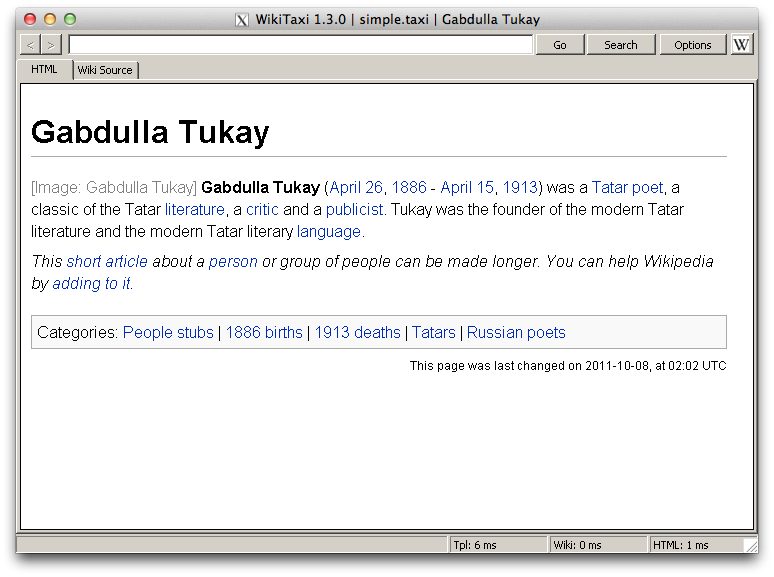
- Install Homebrew.
- brew install --use-gcc wine
- Prefix the WikiTaxi binaries with vino, eastward.g., wine WikiTaxi_Importer.exe, and otherwise follow the instructions on the WikiTaxi page.
It'south non the prettiest solution, but it works quite well.
2010-08-25
Compiling for older versions of Mac OS Ten
In preparation for a pending semi-major release of unpkg, I needed to compile some source for other architectures and older versions of Mac OS X on my Snowfall Leopard MacBook Pro. Afterward quite some time DuckDuckGoing and wrestling with gcc, I came across these combinations of surroundings variables that seem to do the fox. (The following, of class, require the appropriate x.4 and 10.five SDKs to be installed in /Developer/SDKs.)
ten.4 and PowerPC
CC="gcc-4.0 -curvation ppc" \ CXX="g++-4.0 -curvation ppc" \ CFLAGS="-mmacosx-version-min=10.4" \ CPPFLAGS="-DMAC_OS_X_VERSION_MIN_REQUIRED=1040 -nostdinc \ -F/Developer/SDKs/MacOSX10.4u.sdk/System/Library/Frameworks \ -I/Programmer/SDKs/MacOSX10.4u.sdk/usr/lib/gcc/powerpc-apple tree-darwin10/4.0.1/include \ -isystem /Programmer/SDKs/MacOSX10.4u.sdk/usr/include" \ LDFLAGS="-arch ppc -mmacosx-version-min=10.4 \ -50/Developer/SDKs/MacOSX10.4u.sdk/usr/lib \ -F/Developer/SDKs/MacOSX10.4u.sdk/Organization/Library/Frameworks \ -Wl,-syslibroot,/Developer/SDKs/MacOSX10.4u.sdk" \ ./configure --build=`uname -p`-apple-darwin --host=powerpc-apple-darwin
x.4 and i386
CC="gcc-4.0 -curvation i386" \ CXX="g++-4.0 -arch i386" \ CFLAGS="-mmacosx-version-min=10.4" \ CPPFLAGS="-DMAC_OS_X_VERSION_MIN_REQUIRED=1040 -nostdinc \ -F/Developer/SDKs/MacOSX10.4u.sdk/Organization/Library/Frameworks \ -I/Programmer/SDKs/MacOSX10.4u.sdk/usr/lib/gcc/i686-apple-darwin10/4.0.1/include \ -isystem /Developer/SDKs/MacOSX10.4u.sdk/usr/include" \ LDFLAGS="-arch i386 -mmacosx-version-min=ten.4 \ -50/Developer/SDKs/MacOSX10.4u.sdk/usr/lib \ -F/Developer/SDKs/MacOSX10.4u.sdk/System/Library/Frameworks \ -Wl,-syslibroot,/Developer/SDKs/MacOSX10.4u.sdk" \ ./configure
10.five and x86_64 -- the ten.4 gcc-4.0 tin't compile for x86_64, then we have to use x.v instead.
CC="gcc-four.two -curvation x86_64" \ CXX="g++-4.2 -arch x86_64" \ CFLAGS="-mmacosx-version-min=10.5" \ CPPFLAGS="-DMAC_OS_X_VERSION_MIN_REQUIRED=1050 -nostdinc \ -F/Developer/SDKs/MacOSX10.v.sdk/Organization/Library/Frameworks \ -I/Developer/SDKs/MacOSX10.five.sdk/usr/lib/gcc/i686-apple-darwin10/iv.2.i/include \ -isystem /Developer/SDKs/MacOSX10.5.sdk/usr/include" \ LDFLAGS="-arch x86_64 -mmacosx-version-min=x.five \ -L/Developer/SDKs/MacOSX10.5.sdk/usr/lib \ -F/Developer/SDKs/MacOSX10.5.sdk/Organisation/Library/Frameworks \ -Wl,-syslibroot,/Programmer/SDKs/MacOSX10.5.sdk" \ ./configure
Then combine the binaries, like and so:
lipo foo-i386 foo-ppc foo-x86_64 -output foo-fat -create.
2009-12-28
Using SheepShaver on Mac Bone 10
Build as listed on the website. Video uses 10 and sound goes through CoreAudio, so you don't demand SDL. A few other bits of information, though:
- For working keyboard shortcuts, disable "Enable cardinal equivalents nether X11" in X11.app.
- For sound output, select "Built-in" in the Sound control panel.
- Launch with this control:
./SheepShaver --rom /wherever/macos.rom --deejay /wherever/harddrive.img --frameskip 0 --ramsize 268435456 --ignoresegv true --ignoreillegal true --ether slirp --idlewait true --keycodes true --keycodefile keycodes
This gives you working ethernet, keyboard shortcuts, smooth video, 256MB of RAM, and better stability through ignoring SEGV and illegal instructions.
2009-08-25
All the same Another MSI Wind Hackintosh Tutorial
Merely contributing my method. General outline: install OSX on an external drive from a MacBook, then copy the installation to the internal Wind drive.
Requirements:
- MacBook
- Leopard DVD
- External HD / USB drive (I'grand using a 320GB one -- anything that tin can hold an OSX installation should work)
- Mac Bone X ten.5.vii Combo Update
- Chameleon
- SuperDuper!
- CyberGreg's driver pack (google effectually)
Instructions:
- Boot the MacBook from the Leopard DVD.
- Partition the external bulldoze, with a GUID scheme.
- Reboot and install the x.5.seven update (newest x.5.8 doesn't have good support at fourth dimension of writing), reboot.
- Install CyberGreg's driver pack.
- Install Chameleon on the external bulldoze.
- Kick the Wind from the external bulldoze.
- Use SuperDuper to re-create the OSX installation to the interal drive.
- Run Chameleon over again on the interal drive.
Hurrah!
Download Sopcast for Mac Os X 10.5.8
Posted by: ronaldwayshorn81.blogspot.com


0 Komentar
Post a Comment